How to Dress When You’re Big and Tall: The Complete Fit Guide
This is the complete guide to dressing a big and tall build, shirts, pants, jackets, suits, and casual wear, with the real construction reasons behind every recommendation, not just “size up.”
Never miss an update — choose ManPlaybook as your preferred source on Google.
How it works: Tap the button below to open Google’s settings page, then check the box next to ManPlaybook.
Tap the checkbox to turn it blue — that’s how you know it’s set.
I’m not a big and tall guy myself. My own build runs short instead. But I spent years in IT before this. That job taught me one thing. When advice for a whole group of people all sounds the same, and none of it explains why, that’s a sign nobody dug into the real construction. So I did.
This is the full guide, not a single-topic post. You may have read 9 Big & Tall Clothing Mistakes You’re Probably Making already. This is the deeper version. Shirts, pants, jackets, suits, casual wear, and a real shopping checklist, all in one place.
Every tip below comes with the real reason behind it. Not just a rule to follow.
Here’s the short version. Big and tall isn’t one thing to fix, it’s two. Height changes length: your torso, sleeve, rise, and shirt tail. Width changes room: your chest, shoulder, and thigh.
A garment cut for both, instead of one size scaled up, fixes most problems before you even try it on.

Quick answer
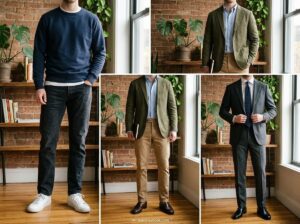
Dressing a big and tall build well means buying clothes cut for both height and width. Not a regular-fit item just sized up. Look for a size chart with sleeve length, torso length, and rise listed as their own numbers. Not one single S, M, L, XL jump.
A few things to look for across every category. Structured shoulders. Double-vented jackets. A mid-to-high rise on your pants. Midweight fabric with real drape. Solid colors or small, tight patterns instead of bold prints. Belts and watches sized up to stay in proportion.
The goal is always the same. Clothes built for your real shape need almost no tailoring. Clothes just scaled up need constant fixing.
Real picks at a glance
| Product | Why it’s here |
|---|---|
| BEFRIED Big and Tall Dress Shirt, XL Big to 6XL Big Tall | Lists Big and Big Tall as separate sizes, not one blended run. |
| Wrangler Authentics Comfort Flex Waist Relaxed Fit Jean | Runs up to a 46-inch waist. The waistband sits at the natural waist, not low-rise. |
| Haggar Smart Wash Performance Suit Separate Jacket, Big & Tall sizes | A true Big & Tall suit separate. Sold by jacket size and length on its own, not as a fixed bundle. |
| VRLEGEND Big and Tall Leather Belt, up to a 70-inch waist | Built at true big and tall widths, not stretched at the last hole. |
1. The two variables: height and width
Everything in this guide comes back to one idea. So it’s worth explaining once, up front.
A standard clothing size grows in one straight line. Go from a Medium to an XL, and every number, chest, sleeve, torso, grows by about the same amount. That works fine if your whole body is bigger in proportion.
It doesn’t work for a big and tall build. Height and width don’t move together here. A 6’5″ man with a 46-inch chest doesn’t need a shirt that’s 20% bigger everywhere. He needs one that’s a lot longer in the torso and sleeve, and only somewhat wider in the chest.
Brian Reaves, COO of DXL, said it plainly in an interview with Retail Dive. “Our fit is spec-ed by size and garment and for each size. We don’t just scale up product from a regular fit like most other retailers.”
The fix, before anything else: look for a size chart that lists sleeve length, torso length, and rise as their own numbers. If a listing only shows one size run, no separate “Tall” or “Big” option, it’s probably just a bigger version of a regular shirt. DXL’s size guide is a good example of a chart done right.

Lists Big and Big Tall as separate sizes, not one blended run.
Shop NowThis post contains affiliate links. We may earn a commission on qualifying purchases at no extra cost to you.
Real mistake people make here: buying based on chest size alone. Then getting frustrated when the sleeves or torso don’t match. Chest size only tells you about width. It says nothing about arm or torso length.
2. Shirts
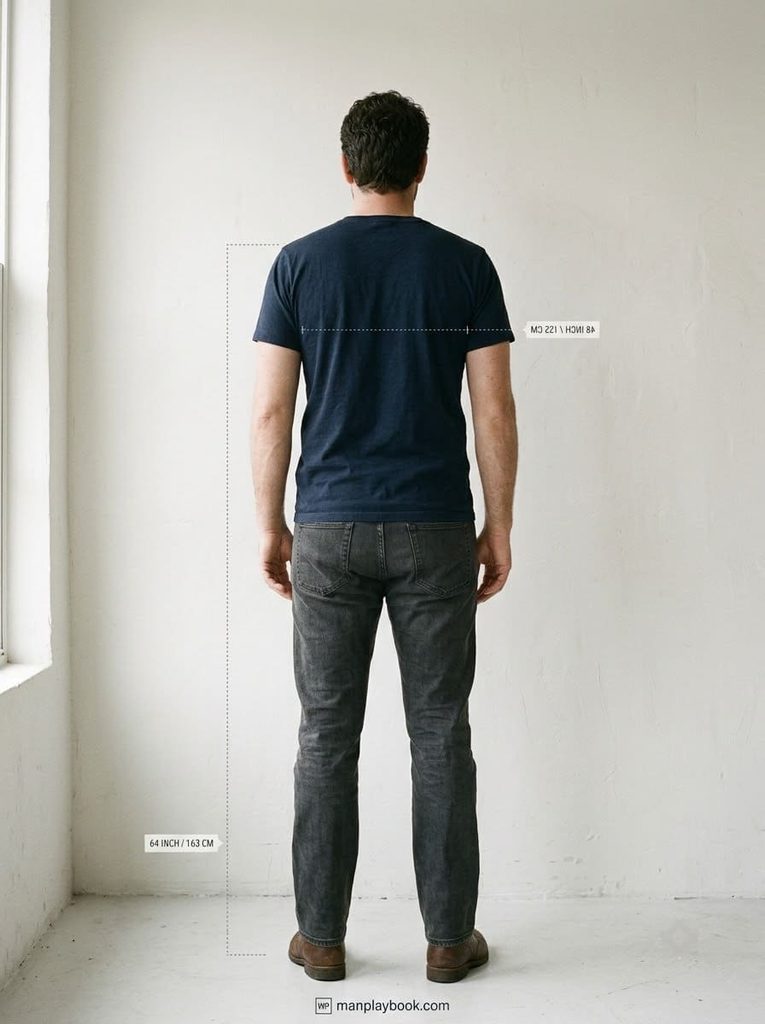
A dress shirt or button-up is the most common fit failure point. Mostly because “bigger” and “longer” get treated as the same fix. They’re not.
Sleeve length should end right at your wristbone. About half an inch of cuff should show past a jacket sleeve. If it stops an inch or two short, that’s a “high water” sleeve. It means the shirt got sized up for chest width, with no extra sleeve length added.
This is a cheap tailoring fix if you already own the shirt. Usually $15 to $25 at a local tailor. But a true big and tall cut skips the fix.
Shirt tail length matters more than most guys think. A shirt cut for a regular torso runs out of tail fabric before it clears a taller frame. That’s why it keeps creeping out of your waistband by early afternoon.
A true big and tall shirt adds 2 to 4 extra inches of length in the tail alone. Not just the overall body length.
Fabric weight should sit in a light-to-midweight range. A stiff, heavy weave holds its own shape instead of following your body. That can add width in places you don’t want it. A lighter poplin or brushed cotton follows your body’s real lines instead.
Collar and cuff fit deserve a check too. A collar that’s too tight leaves a red mark, or forces you to leave the top button open all day. Measure your real neck size and add half an inch of room. Don’t just guess from a regular-fit chart.
Real mistake people make here: buying a longer shirt in the wrong overall size to fix the tucking problem. That adds length to the whole shirt, not the tail specifically. The shirt just gets baggier, and still won’t stay tucked.
Tiered version: if you can only fix one shirt problem, fix the tail length first. It’s the one that shows up every time you sit, reach, or move.
3. Pants and trousers
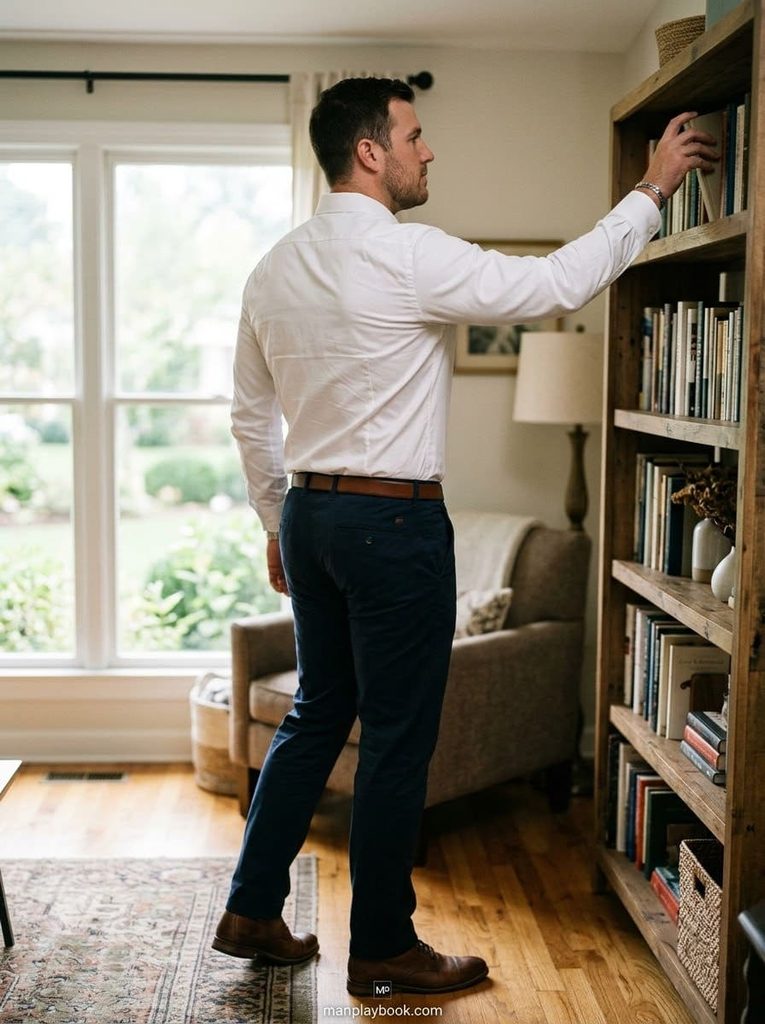
The rise is the measurement from the crotch seam up to the waistband. It’s the most missed number in men’s pants. It matters even more on a big and tall build.
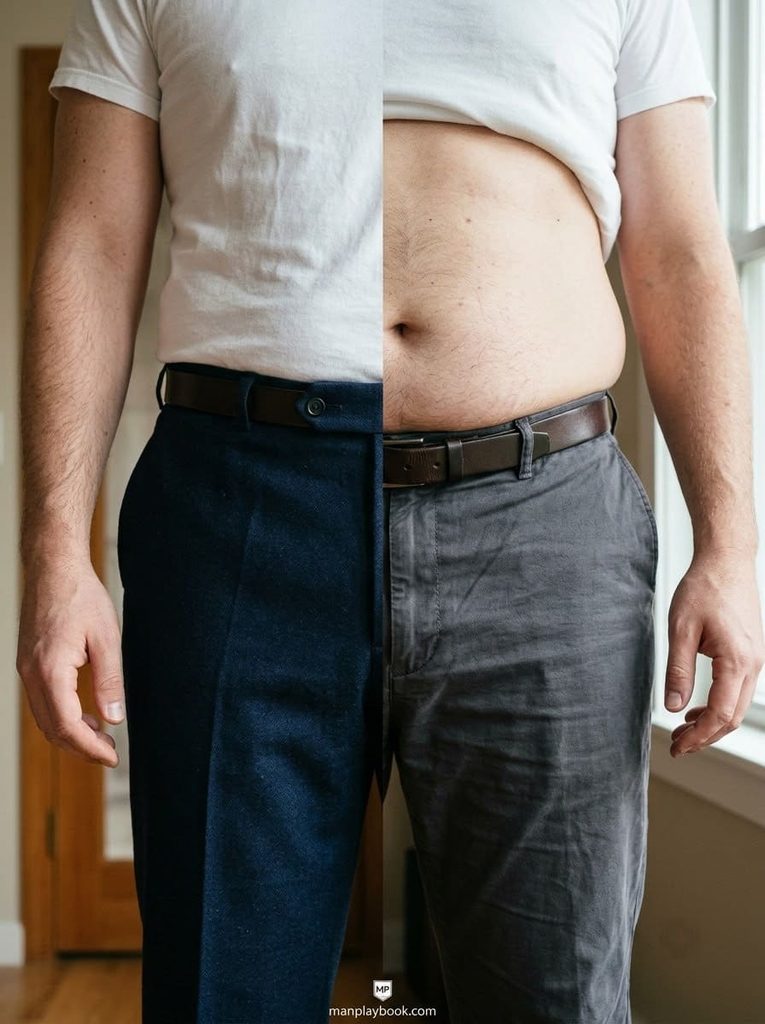
A low rise sits below the widest part of your midsection. That forces the belt to cinch in under your belly to hold the pants up. The cinch creates a fold, and everything above it pushes out over the belt.
A mid-to-high rise sits at or near your natural waist. It lets the fabric fall straight down the front instead.
Check the front rise number on the product page. Not just the waist size. A “34-inch waist” label can come with a completely different rise depending on the cut. The rise is what actually tells you how the pants will sit.
Taper matters too. A straight or slightly tapered leg from the knee down keeps the line clean. It avoids the extra bulk of a relaxed leg pooling at the ankle. A skinny cut fights a broader thigh. It can pull at the seams. Aim for a moderate taper, not a slim-fit extreme.
Check the waistband construction as well. A comfort-waist or gusseted waistband has a stretch panel built into the sides. Pants that fit well in the morning still fit after a big lunch. A rigid waistband with no give has to be sized loose to compensate. That brings back the low-rise cinching problem, just from a different angle.
Real mistake people make here: checking fit standing up, but never sitting down. Pants that look fine standing can dig in hard at the hip crease the moment you sit. A rigid waistband makes it worse.
Tiered version by budget: if you can only replace one pair of pants, replace your everyday pair first. It’s worn the most, and the rise problem shows up every time you sit.
4. Jackets, blazers, and outerwear
Jackets are where construction matters most. This is also where a scaled-up regular block looks the most obviously wrong.
Shoulder structure is the first thing to check. A soft, unstructured shoulder just follows your actual shoulder bone, wherever that sits. A structured shoulder, built with a light seam or padding, extends slightly past your real shoulder line and holds its shape there. On a broader frame, that reads as tailored, not oversized.
Vents matter more than most guys realize. A single vent in the back center, the default on most off-the-rack jackets, has to flex across your whole back alone. Sitting down or reaching pulls it open wide, and your shirt shows through.
A double-vented jacket splits that tension across two side vents instead. Per the Custom Tailors & Designers Association, the trade body for made-to-measure tailors, this exists specifically for broader, more active builds.
Fabric drape works the same way as shirts. Stiff, heavy fabric stands away from the body in a boxy shape. Fabric with real drape follows your actual lines. Labs test this with the ASTM D1388 bend test. It checks how far a fabric strip bends under its own weight. A lower-stiffness result is what “drape” really means.
Sleeve and body length need a separate check too. A jacket can have the right shoulder width and still run short in the sleeve or body, if it’s built off a regular block. Look for the same separate sleeve-length number covered in the shirts section above.
Real mistake people make here: buying a jacket a size up “for room,” without checking where the shoulder seam actually lands. An oversized jacket’s seam sits past your real shoulder point. That reads as sloppy, not broad, the opposite of what you wanted.
Tiered version: a structured shoulder is the highest-impact upgrade if you can only buy one new jacket. The double vent matters most once you’re actually sitting in it a lot, like a daily commute or a desk job.

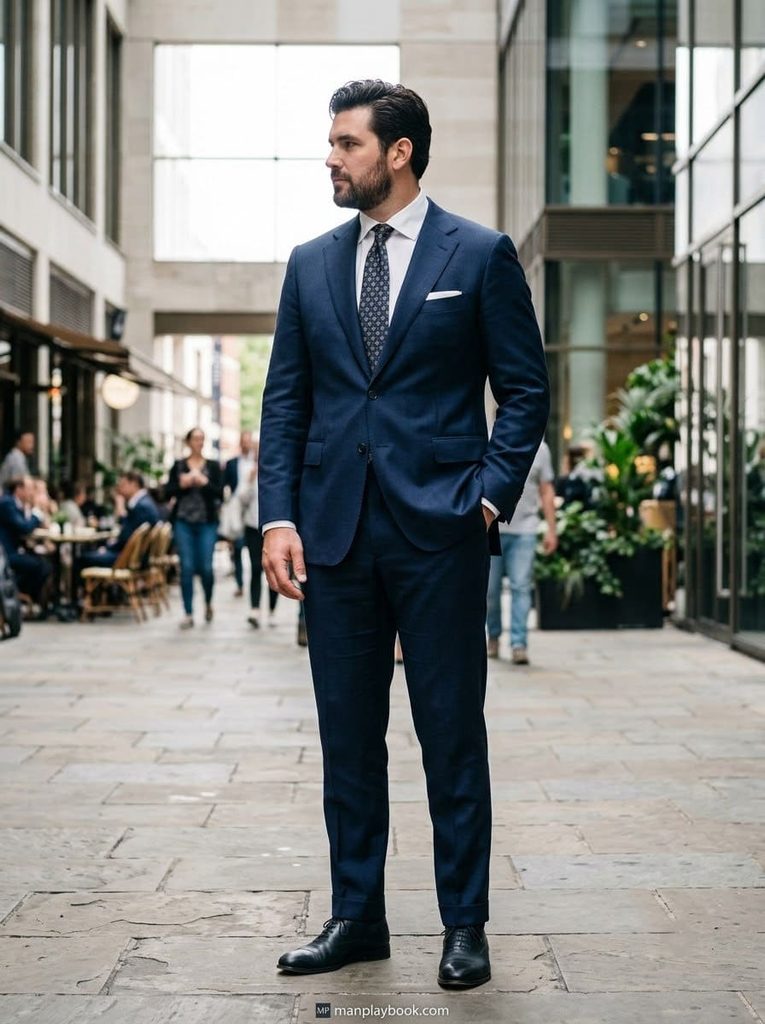
5. Suits
A suit is the highest-stakes big and tall purchase. Fit problems show up under the worst lighting, interviews, weddings, work events. It’s worth its own section.
Buy the jacket and trouser as separates when you can. Not a fixed suit bundle. A big and tall build is far more likely to need a different jacket size and trouser size than a balanced build. A 48 Long jacket with a 42 waist trouser is a completely normal pairing for a broad-shouldered, narrower-waisted man. A bundled suit locks you into one size for both.
Lapel width should scale with your frame, within reason. A too-narrow lapel on a broad chest looks undersized, the same mismatch as a skinny belt on a big frame. A notch lapel around 3.5 to 4 inches wide reads right on a broader chest.
Button stance, where the jacket’s front button sits, should land at or slightly above your natural waist. Not lower. A low button stance visually shortens your torso, and adds bulk right at your midsection.
Trouser break matters here too. A full break, where fabric bunches up at the shoe, adds visual bulk right at the ankle. A slight or no-break hem keeps the leg line clean from waist to shoe.
Real mistake people make here: ordering a suit in the same size as a regular off-the-rack suit from a different brand. Sizing isn’t standard across brands, even within big and tall lines. A “50L” from one label can run noticeably different from another’s.
Tiered version: if budget allows one upgrade over an off-the-rack suit, spend it on separates in the right size relationship. Not a bundled suit in a compromise size. The size mismatch is usually the bigger problem, not the fabric quality.
6. Casual and weekend wear
Casual dressing gets less attention in most big and tall guides. But the same rule applies here too, just with different clothes.
T-shirts and casual knits need the same tail-length and sleeve-length check as dress shirts. A crew neck in midweight cotton, not a thin, clingy jersey, holds its shape better through a normal day.
Layering pieces, overshirts, flannels, light jackets, should have a defined shoulder seam. Not a soft raglan sleeve. Same reason as the jackets section above. A structured piece adds real shape. A soft one just drapes over whatever’s underneath.
Denim and casual pants follow the same rise rule as dress trousers. A comfort-waist or relaxed jean with a real higher rise sits at your natural waist. It skips the low-rise cinch problem from section 3, just in a casual fabric.
Hoodies and sweatshirts deserve their own note. They’re a casual staple most guides skip. A hoodie sized up for chest room usually keeps a hood built for a smaller frame. That can sit oddly tight around a broader neck. Look for hoodies sold with the same extended chest-plus-length sizing as jackets, not just a bigger version of a standard hoodie.
Real mistake people make here: treating “casual” as an excuse to skip fit. Then wondering why the same guy who looks sharp in a blazer looks shapeless in a weekend hoodie. The same rules still apply on weekends.
Variant note for warmer weather: a lightweight linen-cotton shirt, worn a bit looser but still with the right sleeve and tail length, breathes better without breaking the fit rules above. Loose doesn’t have to mean baggy. There’s a real difference between room built into the weave and a shapeless cut.
Tiered version: if you’re building a casual wardrobe from scratch, start with one structured layering piece and one properly rising pair of jeans. Those two cover the widest range of casual days.
7. Color and pattern
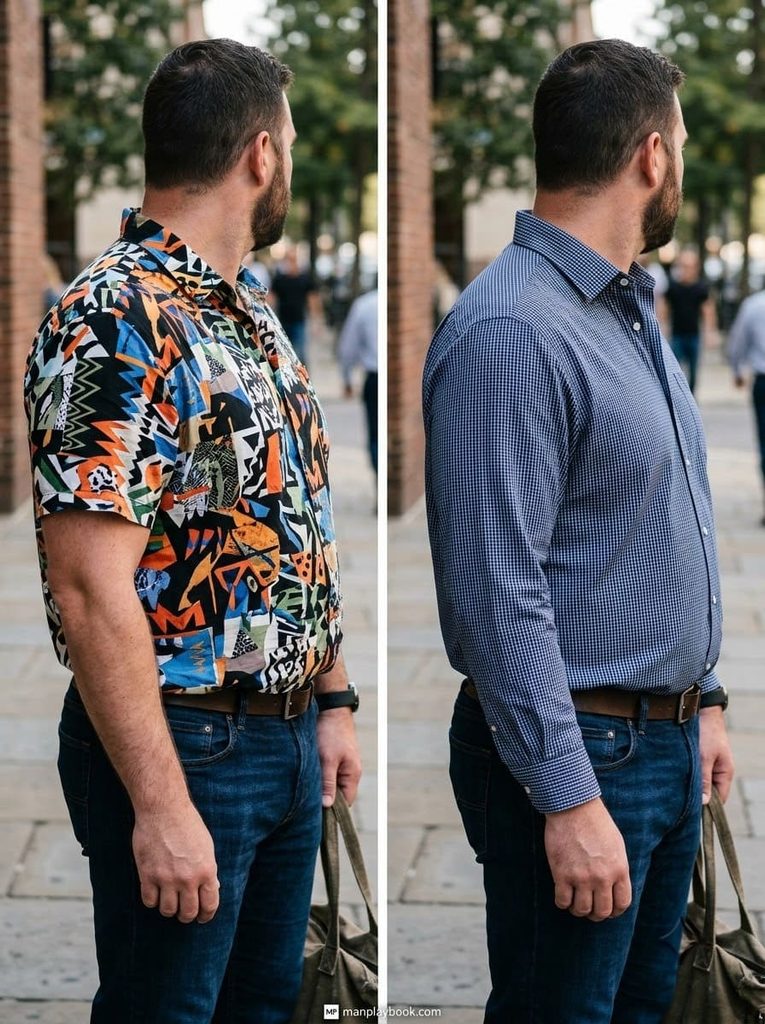
Solid colors and small, tight patterns, a fine herringbone, a subtle micro-check, do the most work on a big and tall frame. A bold, wide print that looks fine on a smaller torso gets louder when stretched across more chest and shoulder. The same print reads busier at a 48 chest than at a 38.
Tonal outfits, keeping your top and bottom in a close color range, read as one shape. Not two halves cut apart at the waist by high contrast. This isn’t about “slimming.” It’s about avoiding a visual break exactly where a broader frame doesn’t need one.
A quick note on vertical details. A little vertical line, a placket, a seam, a subtle pinstripe, can add a touch of visual length without looking staged. But bold stripes head to toe tend to overcorrect. They start reading as loud, not lengthening. Treat this as one small accent, not the whole outfit’s plan.
Real mistake people make here: avoiding color out of habit, sticking to only black and navy. A solid olive, burgundy, or medium gray reads just as clean as black. And it looks like a real choice, not a hiding spot.
Tiered version: start with one solid mid-tone piece, olive or burgundy work well, before trying a full tonal outfit. It’s a low-risk way to test the idea.
8. Accessories
Accessories get skipped constantly. But a small accessory on a big frame reads as undersized by contrast. The same way a golf pencil looks tiny in a large hand.
Belts should scale up to about 1.5 inches wide. A standard 1-inch belt looks pinched on a broader waist. Watches should sit at 42mm or larger, with a wider band to match. Tie knots should lean toward a half-Windsor, not a skinny four-in-hand, which reads thin against a wider collar.
Bags and backpacks scale the same way. A slim laptop bag looks like it’s swallowing whatever’s inside, and can sit oddly against broader shoulders. A structured tote or a backpack with wider straps carries weight better and looks right.
Real mistake people make here: buying accessories in whatever size is easy to find, instead of checking the real width or case size. Most listings do give these numbers. Guys just skip checking them the way they’d check a shirt size.
The rule underneath all of this is simple. Your eye reads size by comparison. A small accessory next to a big frame doesn’t make the frame look smaller. It just makes the accessory look wrong.
9. Where to actually shop
A few retailers build true big and tall patterns, not just scaled-up regular sizes. Worth knowing before you browse generically.
DXL is the largest dedicated big and tall retailer in the US. It carries its own lines plus extended sizing from brands like Polo Ralph Lauren and Levi’s. Fit is specced by size and garment, as covered in section 1.
Bonobos Big & Tall and Todd Snyder’s extended sizing both draft separate patterns, not a scaled regular block. Haggar offers Big & Tall as a real separate size run, not just a bigger cut, across its suits and dress shirts. That’s why it’s the suit-separate pick in the table above.
Watch out for outlet and clearance sections. A deep discount is only a real deal if the size chart still lists separate sleeve, torso, or rise numbers. Some clearance stock comes from an older, scaled-up block, not the brand’s current big and tall line. The discount can come with the same fit problem this whole guide is about fixing.
Shopping checklist before you buy anything:
- Confirm the listing shows sleeve length and torso length, or rise for pants, as separate numbers.
- Check whether “Big & Tall” means a real separate pattern, not just bigger numbers within the same size run.
- Search the brand name plus “big and tall size chart” when in doubt. Most real big and tall lines publish one.
- Compare your own measurements against that chart. Not the size you wear in a different brand.
The pattern behind all of it
Every section above comes back to the same idea from section 1. Height and width are two separate things. Clothes drafted for both need almost no adjustment. Clothes just scaled up need constant fixing, one tailoring trip at a time.
I expected the differences between shirts, suits, and casual wear to be bigger than they turned out to be. It’s really the same handful of ideas, sleeve and torso length, rise, shoulder structure, fabric drape, just applied to different clothes. That made this guide easier to put together than I expected going in.
FAQ
Do I need to shop only at big and tall specialty retailers? Not only, but for shirts, suits, and dress pants, a real big and tall pattern needs far less tailoring than a regular item just sized up.
What’s the single highest-impact fix if I can only change one thing? Rise, on both dress and casual pants. It’s invisible on a hanger or in a photo, but it shows up every single time you sit down.
Is a bundled suit ever fine for a big and tall build? Yes, if your jacket size and trouser size happen to match up well in that specific bundle. Just check the real measurements against your own body first.
How do I know if a hoodie or casual jacket is a true big and tall cut? Check for a separate body-length number next to the chest size. The same signal covered throughout this guide. A hoodie with only a chest size, and no length number, is usually just a bigger regular hoodie.
Products We Recommend
This post contains affiliate links. We may earn a commission on qualifying purchases at no extra cost to you.
BEFRIED Big and Tall Dress Shirt, XL Big to 6XL Big Tall
Lists Big and Big Tall as separate sizes, not one blended run.
Shop Now
Wrangler Authentics Comfort Flex Waist Relaxed Fit Jean
Runs up to a 46-inch waist. The waistband sits at the natural waist, not low-rise.
Shop now
Haggar Smart Wash Performance Suit Separate Jacket, Big & Tall sizes
A true Big & Tall suit separate. Sold by jacket size and length on its own, not as a fixed bundle.
Shop nowNever miss an update — choose ManPlaybook as your preferred source on Google.
How it works: Tap the button below to open Google's settings page, then check the box next to ManPlaybook.
Tap the checkbox to turn it blue — that's how you know it's set.